Conservation
District
Programs
Award Winners
Chesapeake Bay Program
Dirt & Gravel Roads
Envirothon
Erosion Control (Ch 102)
Golf Tournament
Nutrient Management Program
Tree Sale
Watershed Program
District Directors
District Staff
Directions to Office
Resources & Services
Forms
Links
Frequently Asked Questions
District Home Page
Conservation District
310 Allen Road, Suite 301
Carlisle, PA 17013-9101
717-240-7812
Fax 717-240-7813
[email protected]


The Chesapeake Bay Watershed
The Bay Watershed encompasses 6 states and works its way across 64,000 square miles of land before pouring billions of gallons of fresh water into the Chesapeake Bay on a daily basis. This fresh water, carrying essential minerals and nutrients, mixes with salty ocean water creating an estuary with ideal conditions for plant and animal life. Our nation's largest and most productive estuary, the Chesapeake Bay watershed is home to over 15 million people and thousands of plant and animal species.
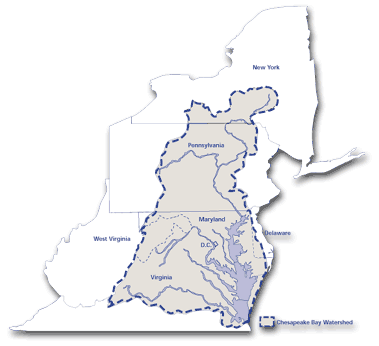
As the water draining into the Bay works its way across the landscape, it picks up pollutants that adversely affect life in the Chesapeake Bay. Rain water carries soil, excess nutrients, fertilizers and pollutants from agricultural operations, streets, industries, lawns and construction sites, ultimately ending up in the Bay. Impacts from these various pollutants can adversely affect the vital species within the Bay and the natural balance of the Bay.
Now, more than ever, people within the Bay drainage region realize that what they do on the land directly affects the health of the Chesapeake Bay. Since 1983, various citizens, private groups, government agencies and businesses have been joining forces to clean up the Bay watershed. In order to restore and protect the resources of the Chesapeake Bay, all of us need to become better stewards of the land.
The Chesapeake Bay Program
The Financial Assistance Funding Program (FAFP), commonly referred to as the Pennsylvania Chesapeake Bay Program, began in 1985. This voluntary program provides financial assistance to implement certain agricultural best management practices (BMPs). These BMPs are designed as part of a comprehensive nutrient management program to address critical farm nutrient problems, reducing surface water and groundwater pollution.
Cumberland County and the Bay Program
The Cumberland County Conservation District first became active in the Chesapeake Bay Program in 1987. The Conservation District employs one Chesapeake Bay Technician and one District Engineer who administer the Bay program within the County. Working closely with other District Staff and the Natural Resources Conservation Service (NRCS), these individuals implement nutrient management programs on farms with critical nutrient concerns. A combination of state and federal funding sources is provided to the District to administer the program.
The Conservation District provides farmers the opportunity to receive both technical and financial assistance to address nutrient concerns. Many of the services offered by the Conservation District are available through the private sector. However, for many operations, the costs incurred through the private sector are prohibitive. The services offered by the Conservation District give landowners the opportunity to address critical nutrient problems with reduced out of pocket expenses.
In the past, each new applicant was ranked based on the operation's potential to pollute the water resources within the Bay Watershed. Typically, the pollution concerns identified were a result of improperly contained and/or applied animal wastes.
Each participating landowner was required to implement a conservation plan addressing soil erosion concerns and a complete nutrient management program which included the BMPs deemed necessary to address nutrient pollution concerns. The proper design and implementation of these components are intended to protect the soil and water resources on the operation, while hopefully improving the farm's manageability and productivity. Ultimately, the goal of every Chesapeake Bay Project is to reduce the amount of nutrient pollution entering the Chesapeake Bay.
The Changing Bay Program
The Bay Program has evolved to using a mix of short and long-term goals to achieve Bay restoration. Two year goals, called milestones, are now implemented with hopes of reaching 60% reduction measures in place by 2017 with a long term goal of having all Bay restoration measures in place by 2025. Many of these restoration measures are being implemented currently which includes nitrogen, phosphorus, and sediment reductions through conservative agriculture practices.
Pennsylvania is currently on track to reach the goal of 60% reduction in phosphorus and sediment loads by 2017 but efforts need to be increased to reach the same goal in nitrogen reductions. Pennsylvania is responsible for 46% of the nitrogen, 26% of the phosphorus, and 31% of the sediment load that is entering into the Chesapeake Bay. BMPs are continuously being implemented to reduce these nutrient and sediment loads.
The Cumberland County Bay Program Tributary Strategy
The Cumberland County Conservation District developed a new Bay Tributary Strategy in February of 2005. Based on existing county trends and needs identified, "10 Core BMPs" were selected to serve as the foundation for the new Strategy.
The following Core BMPs will be the focus of the County's Bay Program:
1. Conservation Planning
2. Conservation Tillage
3. Advanced No Till
4. Cover Crops
5. Nutrient Management
6. Animal Waste Systems
7. Horse Pasture Management
8. Rotational Grazing
9. Precision Agriculture
10. Erosion and Sedimentation Controls
Current Funding Opportunities
Please check back for upcoming information about funding opportunities through the Chesapeake Bay Program. Currently, the PA DEP is reviewing Conservation District requests for funding. When the new budget is finalized, information will be posted about funding opportunities under the new Chesapeake Bay Tributary Strategy.
For more information, please access the PA DEP Chesapeake Bay Program website: http://www.dep.state.pa.us/hosting/pawatersheds/chesapeakebay
To access the complete Cumberland County Chesapeake Bay Tributary Strategy in PDF form, please use the following link:
Cumberland County Chesapeake Bay Tributary Strategy
Contact Information
| Brady Seeley Chesapeake Bay Technician [email protected] |
Michael Lubinsky, PE District Engineer [email protected] |